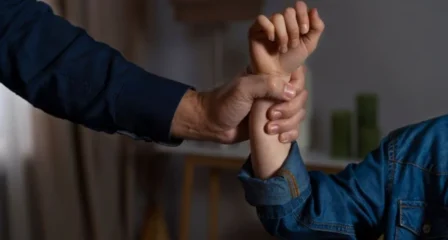
Police can issue a Police Protection Direction (‘PPD’) to help protect a person experiencing violence from another person perpetrating violence.
A PPD is an official document police can issue in response to a domestic violence incident. It has an immediate effect and will be in place for 12 months. It will have conditions that the respondent must comply with. A PPD will say that a respondent must have good behaviour towards the aggrieved or anyone named. It can also include conditions to stop the respondent from approaching, contacting or locating the aggrieved.
A PPD will name an aggrieved (person in need of protection), the respondent (person perpetrating violence) and any other people who need protection such as children and relatives.
Unlike other domestic violence orders, there is no court date after the PPD is issued.
When can police issue a PPD?
Before issuing the PPD, police must attempt to find the respondent and talk to them about issuing the PPD. Like all domestic violence matters which police are involved in, they must investigate the matter prior to issuing the direction.
The police must also provide a copy of the PPD to the aggrieved, respondent and any named person.
Police can issue a PPD in response to a domestic violence incident if:
- They reasonably believe that the respondent has committed domestic
violence; - A PPD is necessary or desirable to protect the aggrieved;
- A domestic violence protection order would not be more appropriate; and
- None of the exclusions apply (exclusions discussed below).
When will police not issue a PPD?
A PPD cannot be issued if:
- The aggrieved or respondent are a child or a police officer;
- There is already a current or expired protection order or PPD;
- The response has been convicted for a domestic violence offence in the last two years or there are any outstanding charges for domestic violence offences;
- There is a current application for a protection order against the respondent;
- The response has used or threatened to use weapon; or
- Police are unable to identify which person is most in need of protection.
What Happens if a PPD is Not Followed?
Once the PPD is in place there are consequences if the respondent does not comply with the conditions. The police will investigate, and may charge the respondent with contravention of the PPD.
Contravening a PPD is a criminal offence, which carries a maximum penalty of 120 penalty units or 3 years imprisonment
Can I change a PPD?
Once a PPD has been issued by a police officer, it is in place for 12 months.
You can ask for the PPD to be changed by:
- Applying for a court review in a Magistrates Court; or
- Requesting a police review.
Application to Review
Magistrates Court Review
An application for court review can be filed by the aggrieved, respondent or other authorised person.
The police will prepare and file documents in response to the application for review.
A magistrate will consider the application and confirm the PPD, order that it ends on a certain day, or decide to make a protection order for up to 5 years.
The PPD remains in effect during the review period unless the court makes a different order.
Police Review
You can apply for a police review of a PPD, if you are the respondent, aggrieved or authorised person. A named person can only seek a review about the decision to name them in a PPD or a condition that relates to them.
Police may also review the PPD if they become aware of new information that was not considered at the time the PPD was issued.
A police review can confirm if the PPD is to remain in place, revoked, or amended to add or remove conditions. If the police revoke the PPD they may also choose to file an Application for a Protection Order or issue a Police Protection Notice.
A police review application must be lodged within 28 days of when the PPD is served on the respondent.
A PPD remains in effect during the review period.
If you believe either:
- PPD has been issued when an exclusion has been applied;
- You have breached the PPD or concerned you may breach it;
- You are unsure how a PPD will affect your employment or family circumstances in the future; or
- Wish to review a PPD through the Court or Police process
Please contact us to obtain urgent and specialised legal advice.
Final Thoughts
Having a PPD issued for 12 months may feel final, and you as if weren’t given an opportunity to defend yourself or tell the other side of the story.
In some cases, police do get it wrong and issue orders to the wrong person. In other cases, the conditions imposed are too restrictive for the reality of the situation and may cause issues if in place for 12 months.
Elysian Law is experienced in domestic and family violence matters and can assist you in navigating this process whether you are a respondent, aggrieved or named person. We are here to help you through this difficult legal process.
It is important that before you seek a review or speak to police about domestic violence matters you obtain specialised legal advice, to ensure you have all the information you need to navigate the system.
For more advice please visit these pages:
At Elysian Law, our team is committed to providing expert legal guidance tailored to your unique needs.
Supportive Services
If you or someone you know is experiencing domestic or family violence, support is available:
Emergency: Call 000 (triple zero) if you are in immediate danger.
1800RESPECT – 24/7 National Domestic, Family and Sexual Violence Counselling Service
Call 1800 737 732 or visit www.1800respect.org.auDV Connect (Queensland) – 24-hour crisis support for women
Call 1800 811 811 | www.dvconnect.orgMensline Australia – Support for men
Call 1300 78 99 78 | www.mensline.org.au

About the author
Laura Summerville
Legal Practice Director & Co-Founder, Elysian Law
Laura is the Legal Practice Director and co-founder of Elysian Law, with extensive experience across Queensland's courts and legal system. She has a particular focus on representing clients in all areas of domestic and family violence, including protection order applications for both aggrieved and respondent parties, criminal proceedings, and Family Law matters involving complex family violence issues.
Laura holds a Bachelor of Laws (Honours) and practises in both family law and criminal defence. She is admitted to practice in Queensland and is a registered member of the Queensland Law Society.